Early Transistors in 1952
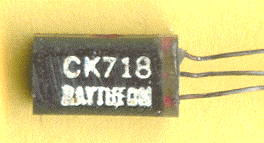
In 1952, the “semiconductor industry” as we know it didn’t really exist. It was a chaotic, experimental field. The term “Silicon Valley” wouldn’t be coined for another two decades, and silicon itself wasn’t even the standard yet.
Junction Transistors were invented by William Shockley in 1948, but they only entered initial commercial production in late 1951/1952. These were much more stable “sandwiches” of P-type and N-type germanium, but they were incredibly difficult to manufacture with high yields. Early transistors were made almost exclusively of germanium because it was easier to purify at lower temperatures. However, germanium had a fatal flaw for military use: it became highly unstable and essentially stopped working at temperatures above 140°F (60°C). Manufacturing was essentially high-tech glassblowing and metallurgy. Out of a batch of 100 transistors made in a lab or early factory line, it was common for 70 to 80 of them to be defective and thrown away. Because of this, a single working transistor could cost anywhere from $15 to $30 (equivalent to hundreds of dollars today).
If a transistor is to be found in Seoul in 1952, it did not get there via commercial trade. It arrived in the kit of the U.S. Military or United Nations forces.
The U.S. Department of Defense was pouring millions into Bell Labs, Raytheon, and General Electric to perfect the transistor. The military’s main goal was miniaturization and ruggedization for Cold War tech: proximity fuzes for artillery shells, lightweight field radios, and early cryptographic or radar equipment.
In May 1954, an engineer named Gordon Teal at Texas Instruments (TI) stunned a conference of radio engineers. After listening to speaker after speaker complain that transistors would never work in hot military aircraft, Teal stood up, announced that TI had secretly cracked the code on purifying silicon, and pulled a working silicon transistor out of his pocket. Silicon can survive temperatures up to 257°F (125°C). Because of this, the U.S. military immediately bought up almost all early silicon production for missiles, jet avionics, and radar. However, silicon was still incredibly difficult and expensive to manufacture. Because of the high cost, civilian electronics stuck with cheap germanium. When the first pocket transistor radios (like the Regency TR-1 in late 1954) and early computers were built, they used germanium.
The tipping point came down to manufacturing geometry. In 1959, Jean Hoerni at Fairchild Semiconductor invented the Planar Process, a way to flat-manufacture transistors on flat silicon wafers using photographic printing (photolithography) and a protective layer of silicon dioxide.
This allowed engineers to stop building individual transistors by hand and start mass-printing thousands of them on a single slice of silicon. This breakthrough directly led to the invention of the Integrated Circuit (the microchip) and heralded the start of the Information Age.
Photograph: Raytheon transistor C718, introduced 1952